

You’ve run the file. The A lenders said no. The B options are marginal at best. Your client is waiting for an answer, and you’re looking at a deal with real merit that just doesn’t fit the standard mould.
The question brokers face in this moment isn’t really “is this a private deal?” It’s “is private genuinely the right call, and how do I know for certain?”
Recommending a private lender too early can add unnecessary cost for your client. Waiting too long, or missing the signal entirely, can mean a lost deal, a frustrated client, or worse, a referral to someone less scrupulous who says yes to everything without explaining the implications.
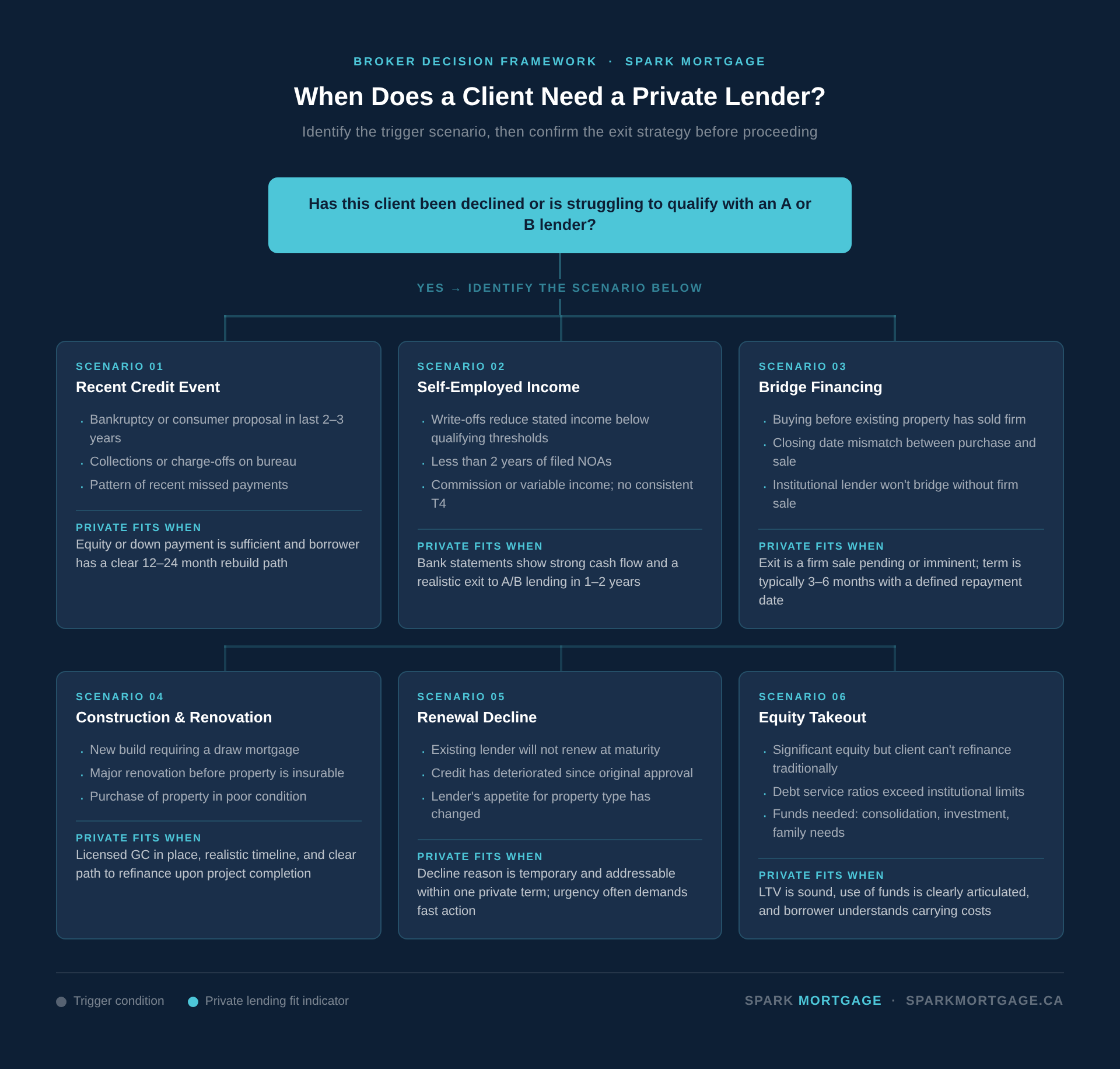
This framework gives you a practical tool for making that call with confidence. Below are the six borrower scenarios where private lending makes genuine sense, along with a decision tree you can reference in your practice, followed by guidance on what separates a trustworthy private lender from the rest.
Why Private Lending Has Earned a Permanent Place in the Broker’s Toolkit
The conversation around private mortgages has shifted. A decade ago, recommending private financing carried a stigma: it meant the file was too messy to place anywhere else. That perception has evolved for good reason.
Canada’s lending environment has tightened in ways that affect creditworthy, capable borrowers. The mortgage stress test disqualifies applicants whose incomes are solid but whose qualifying rate falls short. B lenders have narrowed their appetite for certain property types and borrower profiles. And a growing share of the workforce, including independent contractors, business owners, and commission earners, generates income that doesn’t fit neatly into a T4.
Private lending fills a structural gap in the market. It is not a fallback for borrowers who are simply bad risks. For the right client, in the right scenario, it is the most practical, efficient path to a mortgage, often with a clearly defined exit back to traditional lending within 12 to 24 months.
The brokers who serve their clients best are the ones who can recognize these situations quickly, communicate the reasoning clearly, and work with a private lender who prioritizes the borrower’s long-term outcome over a quick close.
The Six Scenarios: A Decision Framework
The infographic below maps the most common situations where private lending is genuinely the right recommendation. Each scenario includes the key trigger conditions and the equity or exit factors that make private a sound fit rather than a default.
A closer look at the six scenarios
Credit events are among the most common private referrals, and also among the most misunderstood. A past bankruptcy or consumer proposal doesn’t define a borrower’s current financial behaviour. What matters is how long ago the event occurred, what caused it, and what the picture looks like today. Private lending creates the breathing room for a borrower to rebuild their credit profile while maintaining stable housing, often setting them up for a clean institutional mortgage within two renewal cycles.
Self-employed borrowers are chronically underserved by traditional lending guidelines. The same write-offs that make good tax sense often torpedo a mortgage application. Private lenders who are willing to look at business bank statements, cash flow patterns, and the overall health of a borrower’s operation can make approval decisions that reflect reality rather than a single line on a tax return. Many of these clients are excellent borrowers; the system just isn’t built to see them that way.
Bridge financing, construction lending, equity takeout, and renewal declines each represent scenarios where the timeline or the structure of the deal doesn’t align with what institutional lenders are set up to handle. In each case, the private option isn’t a compromise; it’s a purpose-built solution for a temporary or situational gap. The key in every scenario is identifying the exit early, confirming the security position, and making sure the borrower understands what they’re committing to and for how long.
A few important notes on using this framework: a client may present with more than one scenario at once, for example, a self-employed borrower who also needs a bridge. That doesn’t make the referral more complicated; it often makes the case for private lending clearer. What matters in every scenario is that there is an identifiable exit strategy and sufficient security backing the loan.
If a client fits none of the six scenarios above, or if the equity position is too thin to support private rates and fees, it’s worth revisiting whether all institutional options have been exhausted before proceeding. The best brokers ask this question every time, and so do the best private lenders.
What to Look for in a Private Lender
When you refer a client to a private lender, your reputation travels with that referral. The quality of the lender you choose reflects directly on your practice. Here’s what separates a private lender worth working with from one that will create headaches for you and your client.
Upfront transparency on rates and fees
There should be no ambiguity about costs before anything is signed. A lender who is vague about lender fees, commitment fees, or legal costs at the outset will create friction at closing. The right lender presents a clear cost picture early, so your client can make an informed decision.
Common-sense underwriting, not a rigid checklist
The entire value proposition of private lending is flexibility. A private lender who applies the same overlays and automated scoring as a bank offers very little additional value to the broker. Look for a lender who actually reads the file, understands the story, and makes a decision based on the full picture, not just the numbers.
Speed and clear communication
Many private referrals are time-sensitive, especially bridge and renewal decline scenarios. A lender who can give you a clear answer quickly, whether that answer is yes, no, or here’s what we’d need, is worth far more than one who goes quiet for days. You should never have to wonder where your file stands.
A genuine conversation about the exit strategy
The best private lenders are not trying to keep clients in private mortgages indefinitely. They should be asking, from the very first conversation, what needs to happen for this borrower to qualify with an A or B lender at renewal. If a lender isn’t asking about the exit, that’s a signal worth paying attention to.
Willingness to say no when it isn’t a fit
A private lender who takes every deal that comes through the door is not a partner; it’s a risk. The right lender will tell you clearly when a file doesn’t work for them, and ideally, will explain why. That kind of transparency builds trust over time, and it protects your clients from being placed in financing that doesn’t serve them.
Setting the Right Expectations with Your Client
One of the most important parts of any private referral is the conversation you have with your client before the deal is placed. Private mortgage rates are higher than institutional rates, and that cost needs to be contextualised clearly and honestly.
The framing that resonates most with borrowers is this: private lending is a short-term tool to solve a specific problem, not a long-term financing strategy. The cost of private lending for one year, when weighed against the alternative, whether that’s losing a property, missing a closing date, or carrying high-interest debt, is often the most financially sound decision available. When you present it that way, and when the numbers actually support it, most clients understand.
What erodes trust, on the other hand, is when a client feels they were placed in private financing without a clear explanation of why, or without a concrete plan to transition out. That’s a conversation that happens before commitment, not after.
The Bottom Line
Private lending isn’t the right answer for every difficult file. But for the six scenarios outlined in this framework, it is often not just a viable option; for many borrowers, it’s the best one available. The brokers who serve their clients well are the ones who can identify these situations clearly, move with confidence, and work with a private lender who is as invested in the client’s long-term outcome as they are.
That’s what Spark Mortgage was built to be: a practical, transparent lending partner for brokers dealing with complex borrower situations. We’re not a MIC, which means we have the flexibility to look at your client’s file with fresh eyes and make decisions that make sense, not just decisions that fit a template. We move quickly, we communicate clearly, and the exit strategy is always part of the first conversation.
Have a File That Fits One of These Scenarios?
Reach out to the Spark Mortgage team. We’ll give you a straight answer quickly, and we’re always happy to talk through a deal before you formally submit.